
What the bank is actually assessing
A South African lender looks at three things: your gross income, your existing debt obligations, and your conduct on credit. The National Credit Act obliges the bank to check that the loan is not reckless, so affordability is assessed on documented income and disclosed commitments, not on optimism.
- Gross monthly income, supported by payslips or, if self-employed, financial statements and bank statements.
- Total monthly debt repayments, including vehicle finance, credit cards, store accounts and student loans.
- Living expenses, which the bank estimates or verifies from your bank statements.
- Credit record and payment behaviour over the past 24 months.
Most lenders will allow total debt repayments of roughly 30% to 36% of gross income, with the bond itself usually capped near 30%. The exact ratio moves with your credit profile and the loan-to-value you are asking for.
Working backwards from the instalment
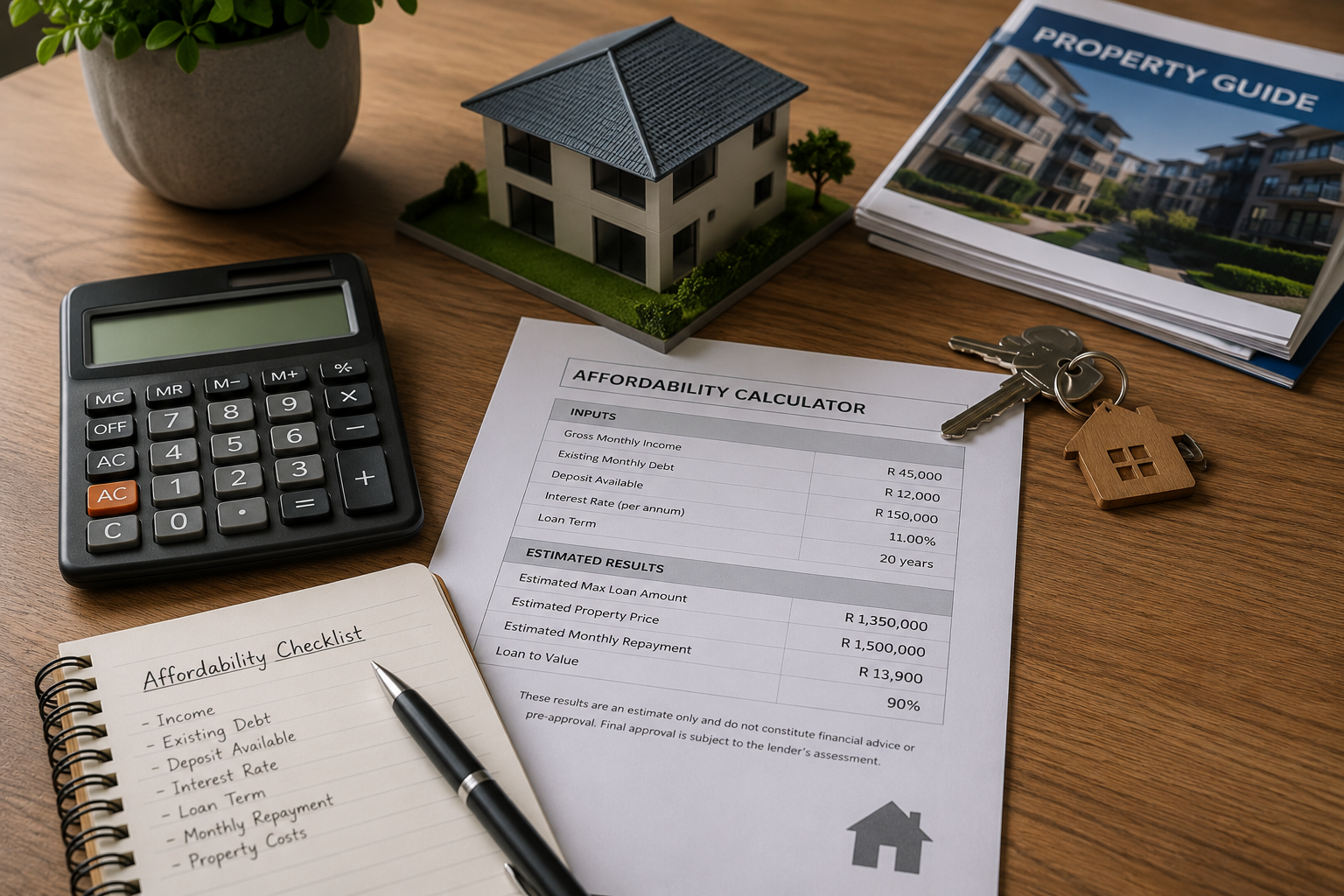
The practical method is to work backwards. Take 30% of gross monthly income, subtract existing debt repayments, and you have the instalment the bank is likely to allow. Convert that instalment into a bond amount at the current rate over your intended term, then add your deposit. That is your indicative purchase price.
- 1
Gross income
Before deductions
- 2
Available instalment
Roughly 30% of income, less existing debt
- 3
Bond amount
Instalment converted at the current rate and term
- 4
Purchase price
Bond plus deposit, less acquisition costs
Why existing debt costs you more than you think
Every rand of monthly debt repayment removes roughly the same rand from your available bond instalment, and each rand of instalment supports around R95 to R105 of bond at typical rates over 20 years. A R5 000 vehicle instalment therefore removes close to half a million rand of purchase power.
Settling short-term debt before applying is usually the fastest way to raise the price you qualify for. It also improves the rate you are offered, which compounds across the full term.
Affordability on an investment property
On an investment purchase, most lenders will consider a portion of the expected rental income, commonly between 50% and 80%, and usually only where there is a signed lease or a credible market rental assessment. Do not assume the rent will carry the bond in the bank's view, and do not assume it in your own.
Professional tips
- • Settle short-term debt before you apply. It raises both the amount and the rate you are offered.
- • Run the instalment two percentage points above the current rate before you commit.
- • Get a pre-approval so your offer is credible and your range is realistic.
Common mistakes to avoid
- • Treating the bank's maximum approval as a budget rather than a ceiling.
- • Leaving vehicle and store credit in place while applying.
- • Forgetting that acquisition costs are paid in cash and are not financed.
Frequently asked questions
How much of my income can go towards a bond?+
Does rental income improve what I qualify for?+
Should I use my full deposit?+
Key takeaways
- Affordability is set by income less existing debt, not by the asking price.
- Roughly 30% of gross income is the practical bond instalment ceiling.
- Every R1 000 of monthly debt removes around R100 000 of purchase power.
- Stress-test the instalment two percentage points higher before you commit.
- On an investment, budget for the full carrying cost, not only the bond.
Model it for your property
Run the numbers with our free calculators.
References
About the author
BookingLoop Advisory
Property finance desk
BookingLoop's advisory team works with residential owners and investors on affordability, acquisition costs, financing structure and letting performance across South African metros.
Published 14 January 2026 · Last updated 3 February 2026
Want a defensible price range?
Send us your income, debt and deposit position. We will set a realistic buying range before you start viewing.
Related guides
How to Prepare for a Home Loan Application in South Africa
The practical six-month plan banks want to see before you apply, credit, deposit, debt-to-income and documentation.
Read guide FinancingDeposit and Purchase Costs: What You Actually Need in Cash
Transfer duty, conveyancing, bond registration, initiation fees and compliance certificates. The costs that sit between an accepted offer and the keys.
Read guide InvestmentWill the Rent Cover the Bond?
How to test whether a residential rental funds itself, and why a small monthly shortfall is not automatically a bad investment.
Read guide